Turn on a tap, eat a meal, walk beside a river after heavy rain. In each moment you are benefiting from an ecosystem, whether or not you notice it. Soils help grow food. Wetlands and forests influence water quality and flow. Landscapes provide places for recreation, culture and livelihoods. Most of the time these benefits arrive quietly, without a price tag or a bill, which is exactly why they are so easy to take for granted.
Researchers call these benefits ecosystem services. Examining them, and how they can be sustained for future generations, is one of the core research themes at the Integrative Human-Environment Dynamics Lab (IHED Lab). This post explains what ecosystem services are, why land use and governance shape them, and what it takes to keep them flowing.
A way of seeing what nature provides
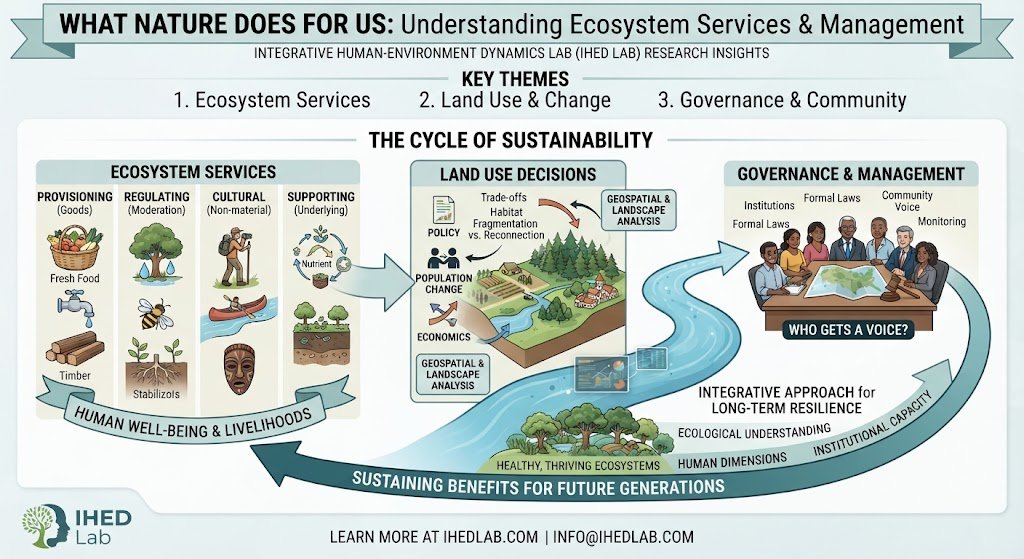
The idea behind ecosystem services is straightforward: healthy ecosystems provide benefits that support human well-being. These benefits are often grouped into a few broad categories.
- Provisioning services are the tangible goods we take from nature, such as food, freshwater, timber and fiber.
- Regulating services are the ways ecosystems moderate conditions, such as filtering water, buffering floods, supporting pollination and helping stabilize soils.
- Cultural services are the non-material benefits, including recreation, spiritual and cultural value, and a sense of place.
- Supporting services are the underlying processes that make the others possible, such as nutrient cycling and soil formation.
Framing nature this way helps make the stakes visible. It reminds us that protecting an ecosystem is not only about protecting wildlife or scenery. It is also about protecting the functions that communities depend on for their daily lives and livelihoods.
Benefits that are easy to overlook
Ecosystem services tend to become visible only when they are lost. A watershed that once filtered and stored water reliably starts to struggle. A landscape that once supported livelihoods changes, and the people who depended on it feel the effects first. A natural buffer that quietly reduced risk disappears, and the consequences arrive with the next storm or dry season.
Part of our work is to make these relationships easier to see. That means studying the connection between ecological functions, natural resources and human well-being, so that the value of a healthy ecosystem is understood in terms of the people who rely on it. It also means recognizing that benefits are not experienced equally. Some groups depend directly on ecosystem services for their food, water and income, while others are more insulated. Understanding who relies on what is central to fair and effective management.
Why land use matters so much
Ecosystem services do not exist in a vacuum. They are shaped by how land is used, and land use itself is shaped by many pressures: policy, population change, economic opportunity and environmental conditions.
Our research on land use change looks at exactly this chain. How do land-use patterns shift over time? What drives those shifts? And what do they mean for the landscapes and communities involved?
A single land-use decision can ripple outward. Converting a piece of land from one use to another may increase production of one service while reducing others. A change that boosts short-term income might reduce a landscape’s ability to hold water or support diverse habitats. Because these trade-offs often play out gradually and across large areas, they can be difficult to recognize without careful analysis.
Geospatial and landscape analysis helps here. By examining spatial patterns and environmental change across watersheds, agricultural systems and other socio-ecological settings, we can see where change is concentrated, how landscapes are fragmenting or reconnecting, and which areas may be most sensitive. Combined with field research, this lets us connect patterns on a map to conditions on the ground and to the lived experience of the people there.
The missing piece: governance
Even with excellent ecological data, resources can be mismanaged if the decision-making around them is weak, unclear or unfair. This is why natural resource governance sits at the heart of our work.
Governance is about how institutions, policies and communities make decisions regarding shared resources such as water, forests and land. It includes formal laws and regulations, but it also includes local rules, customs, relationships and the everyday negotiations that determine who can use a resource, when, and how much.
Shared resources are especially challenging. When many people draw on the same source, each individual’s choices affect everyone else. Decades of research on shared resources have shown that outcomes depend heavily on the institutions in place: whether rules are clear, whether they are seen as legitimate, whether people can monitor use and resolve disputes, and whether those affected have a say in making the rules.
Some questions we find ourselves returning to:
- Who gets a voice when decisions about a shared resource are made?
- How do formal rules interact with local knowledge and traditional practices?
- What happens to ecosystem services when institutions are stretched or incentives point the wrong way?
- How can governance adapt as environmental conditions and community needs change?
Good governance does not guarantee good outcomes, but poor governance almost always makes good outcomes harder to achieve.
Water as a case in point
Water shows how all of these threads come together. Responsible water conservation, watershed resilience and resource planning depend on several kinds of understanding at once:
- Ecological understanding of how a watershed functions, including how vegetation, soils and landscape features influence water movement and quality.
- Spatial understanding of how the landscape is changing and where pressures are building.
- Institutional understanding of who manages, allocates and uses the water, and under what rules.
- Human-dimensions understanding of how people’s needs, livelihoods and decisions shape demand and stewardship.
Studying any one of these in isolation gives an incomplete answer. A technically sound plan can fail if it ignores how people actually use water. A well-intentioned rule can fall short if it does not reflect conditions in the watershed. An integrative approach brings these perspectives into the same conversation.
Agriculture belongs in the picture too
Farming is both a major user of ecosystem services and a major influence on them. Healthy soils, reliable water and pollination support productive farms, while farming practices in turn affect soils, water quality, habitat and the wider landscape.
Our work on sustainable agriculture explores farming systems and practices that support food security, environmental health and long-term resilience. Looking at agriculture within its broader ecological, social and natural-resource context helps reveal where practices can work with ecosystems rather than against them, and what conditions make it realistic for farmers to adopt them. Practices only matter if people can put them into use, so economic, institutional and community factors are part of the question.
Sustaining benefits for the long term
The phrase “for future generations” matters here. Ecosystem services are not only about what we gain today but about what remains available tomorrow. Sustaining them takes three things working together:
- Ecological knowledge of how ecosystems function and what they need to keep providing benefits.
- Honest attention to human decisions, including the incentives, pressures and constraints that shape how people use land and water.
- Institutions able to manage shared resources fairly, and flexible enough to adapt as conditions change.
Remove any one of these and the others struggle. That combination is what the IHED Lab tries to bring to every project: research that connects scientific understanding with the practical questions facing people, communities and natural-resource systems.
Why this matters now
Environmental conditions are changing, populations shift, and demand on land and water continues to evolve. In that context, the benefits that ecosystems provide cannot be assumed to continue indefinitely. Understanding them, valuing them and governing them well are practical necessities, particularly for communities whose livelihoods depend most directly on natural resources.
The encouraging part is that knowledge can make a difference. When communities and decision-makers can see how land use, ecosystem services and governance fit together, they are better placed to make choices that protect what matters most.
Working on a land, water or ecosystem question? Reach out to the IHED Lab at info@ihedlab.com to explore a collaboration.